
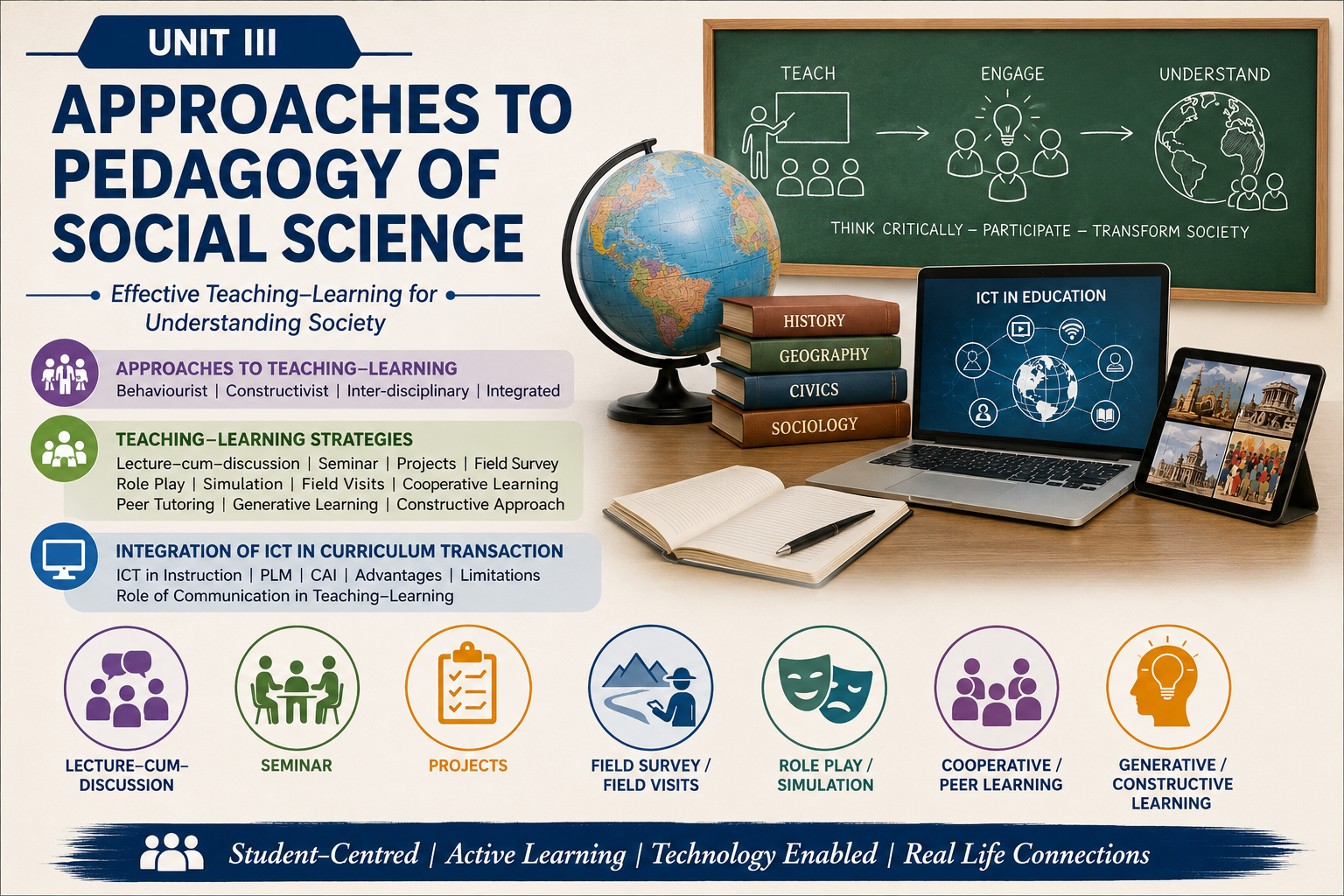
This Moodle course is designed to provide M.Ed. students with a comprehensive understanding of contemporary pedagogical approaches and instructional practices in Social Science Education. The course critically examines major teaching-learning approaches, including the Behaviourist, Constructivist, Interdisciplinary, and Integrated approaches, enabling learners to evaluate their theoretical foundations, classroom applications, strengths, and limitations. Students will explore a variety of learner-centred teaching-learning strategies such as lecture-cum-discussion, seminars, projects, field surveys, role play, simulations, field visits, cooperative learning, peer tutoring, and generative learning, with emphasis on their effectiveness in promoting active engagement and critical thinking.
A significant component of the course focuses on the integration of Information and Communication Technology (ICT) in curriculum transaction. Learners will examine the relationship between curriculum transaction and instruction, the role of ICT in enhancing teaching-learning processes, and the educational applications of various ICT modes such as Programmed Learning Material (PLM) and Computer-Assisted Instruction (CAI). The course also analyses the advantages, limitations, and communication processes involved in technology-enabled instruction. Through interactive Moodle activities, discussions, assignments, quizzes, and collaborative tasks, students will develop the knowledge and skills required to design effective, inclusive, and technology-supported pedagogical practices for Social Science classrooms
- Teacher: Komal Sharma