
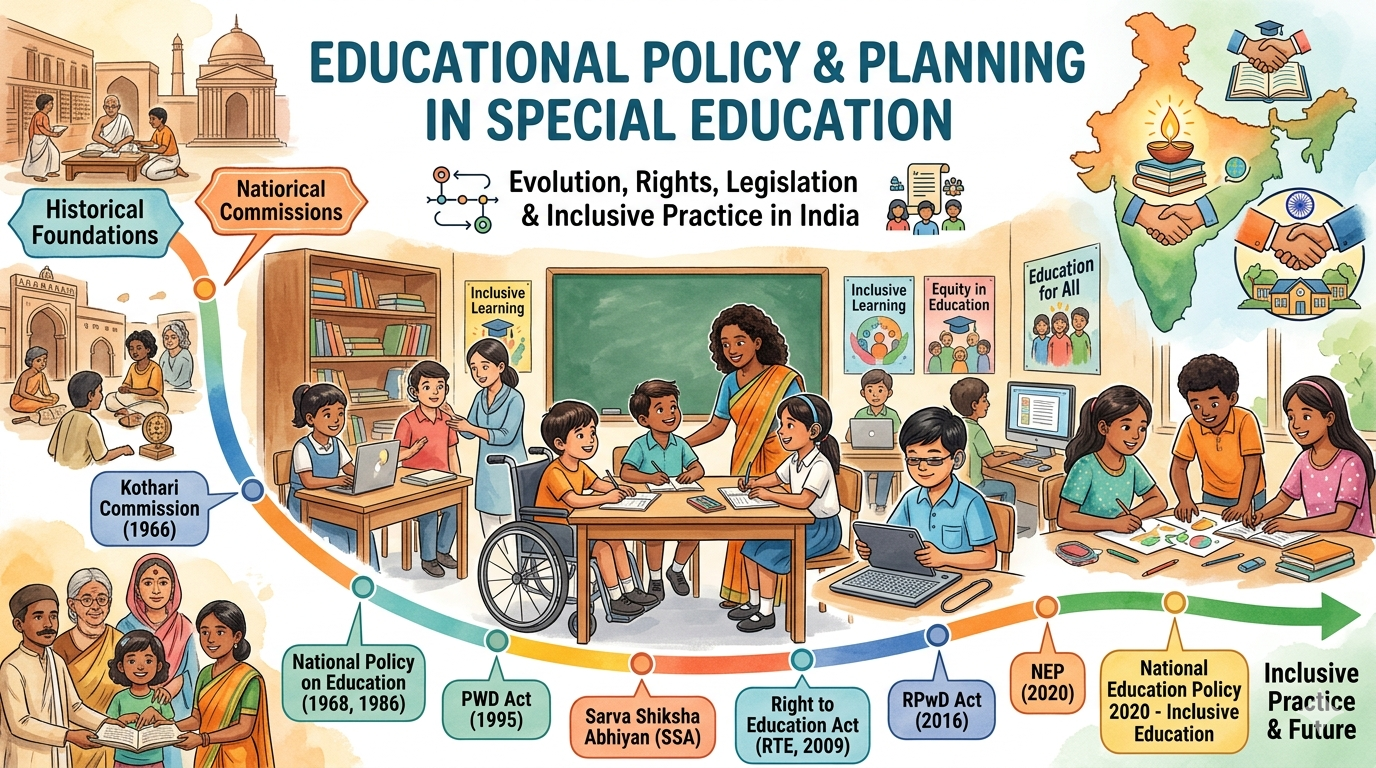
This course introduces learners to the evolution of educational policies, key provisions, and historical developments influencing special and inclusive education in India. It explores the philosophical, constitutional, and legislative foundations of education with special reference to children with disabilities and diverse learning needs. The course examines major commissions, committees, acts, and national policies that have shaped educational practices, including the Rights of Persons with Disabilities (RPwD) Act, National Education Policy (NEP), and inclusive education initiatives. Learners will understand the role of national and international agencies in promoting equitable and accessible education. Emphasis is placed on analyzing policy implications for teachers, schools, and society in creating inclusive learning environments. The course also develops awareness of current educational reforms, challenges, and opportunities in special education. By the end of the course, students will critically evaluate educational policies and apply their understanding in professional practice as future special educators.
- Teacher: Suman Gupta
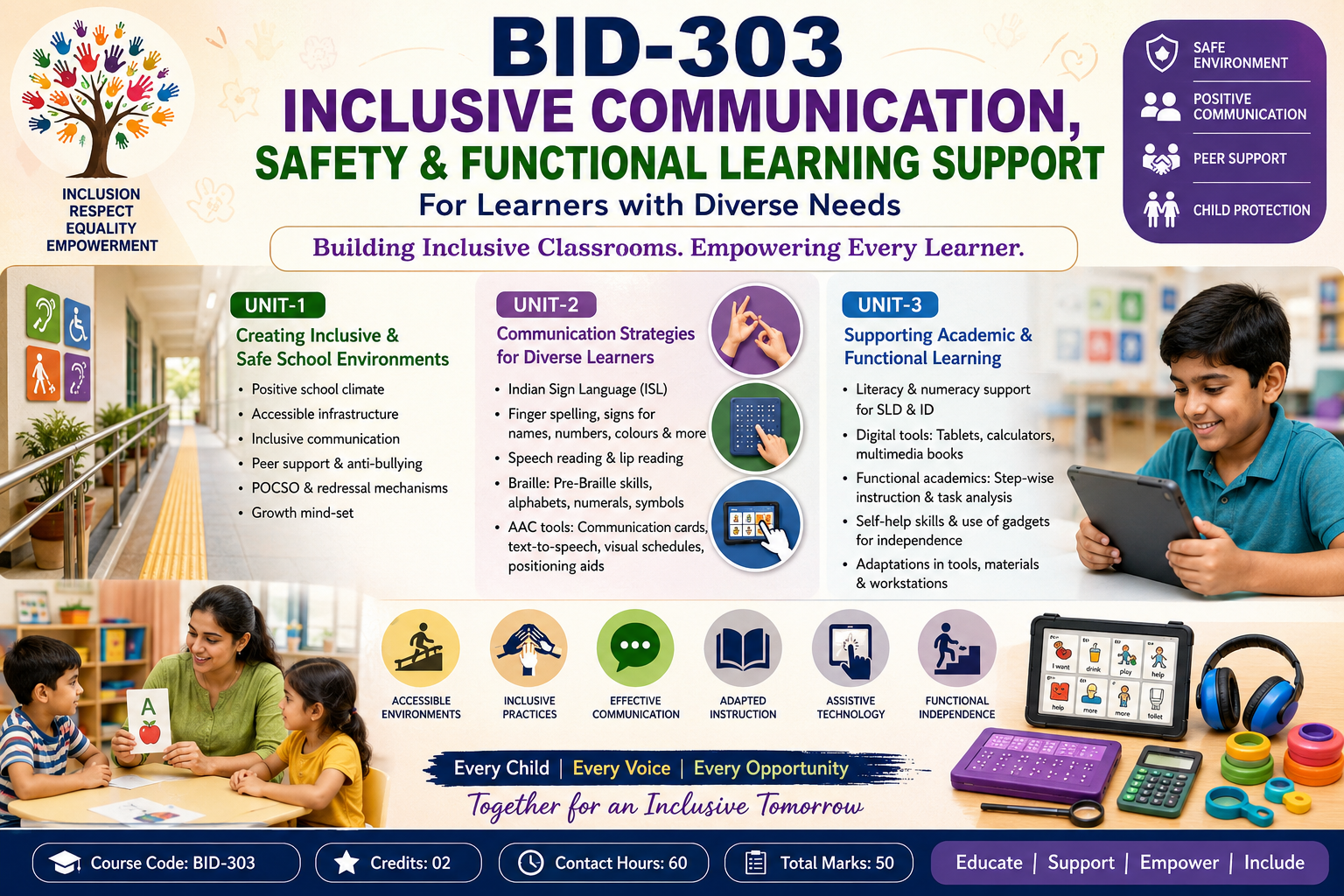
- The course BID-303 prepares B.Ed. Special Education (ID) student-teachers to create inclusive, safe, and accessible learning environments for learners with diverse disabilities.
- It develops understanding about positive school climate, inclusive policies, accessible infrastructure, and learner-friendly classrooms.
- The course emphasizes respectful communication, peer support systems, anti-bullying practices, and child protection mechanisms in schools.
- It introduces communication strategies for learners with sensory and neurodevelopmental disabilities through Indian Sign Language (ISL), Braille, tactile communication, speech reading, and lip reading.
- Student-teachers learn the use of Augmentative and Alternative Communication (AAC) tools such as communication cards, visual schedules, and text-to-speech devices.
- The course focuses on supporting literacy and numeracy skills among students with Intellectual Disability (ID) and Specific Learning Disability (SLD).
- It includes instructional strategies like chunking, task analysis, graphic organizers, collaborative learning, and structured teaching methods.
- The use of digital tools, multimedia resources, tablets, calculators, and adapted teaching-learning materials is also emphasized.
- The course promotes functional academics, self-help skills, and independent living competencies for students with developmental disabilities.
- Overall, the course equips future special educators with inclusive teaching skills, assistive communication techniques, and practical intervention strategies for diverse learners.
- Teacher: Raj Pawan
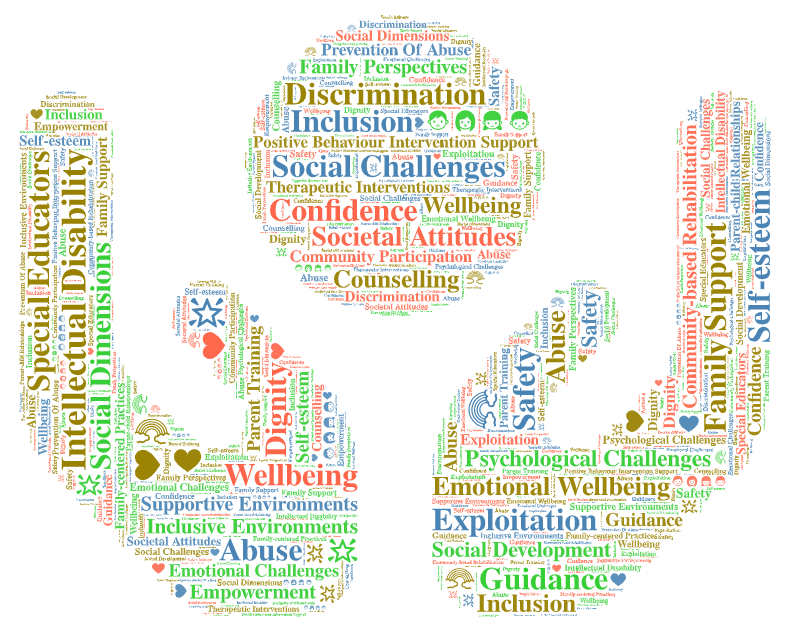
This course focuses on the psychological, social, and family-related challenges faced by individuals with intellectual disability (ID) and highlights the important role of special educators in promoting wellbeing, inclusion, and family support.
The course begins with the psychological aspects of intellectual disability, including the meaning and misconceptions associated with ID. It emphasizes the need to build self-esteem, confidence, and emotional wellbeing through supportive environments and Positive Behaviour Intervention Support (PBIS).
The second unit discusses the social dimensions of disability, such as exploitation, abuse, child labour, discrimination, and negative societal attitudes. It explains how disability affects social development and stresses the importance of creating inclusive environments through community participation and Community-Based Rehabilitation (CBR).
The course also examines family perspectives and emotional challenges. Families often experience shock, guilt, fear, overprotection, or neglect after the diagnosis of a child with intellectual disability. Guidance, counselling, and strong parent-child relationships are highlighted as essential for healthy adjustment and development.
Finally, the course focuses on empowering families through family-centered practices, parent training programs, and therapeutic interventions. It also stresses the prevention of physical, emotional, psychological, and sexual abuse, ensuring the safety and dignity of individuals with intellectual disability.
Overall, the course prepares special educators to support individuals with ID and their families by promoting emotional wellbeing, social inclusion, family empowerment, and safe learning environments.
- Teacher: Anuradha Thakur